
No products in the basket.
Articles
What are Deck Shoes?
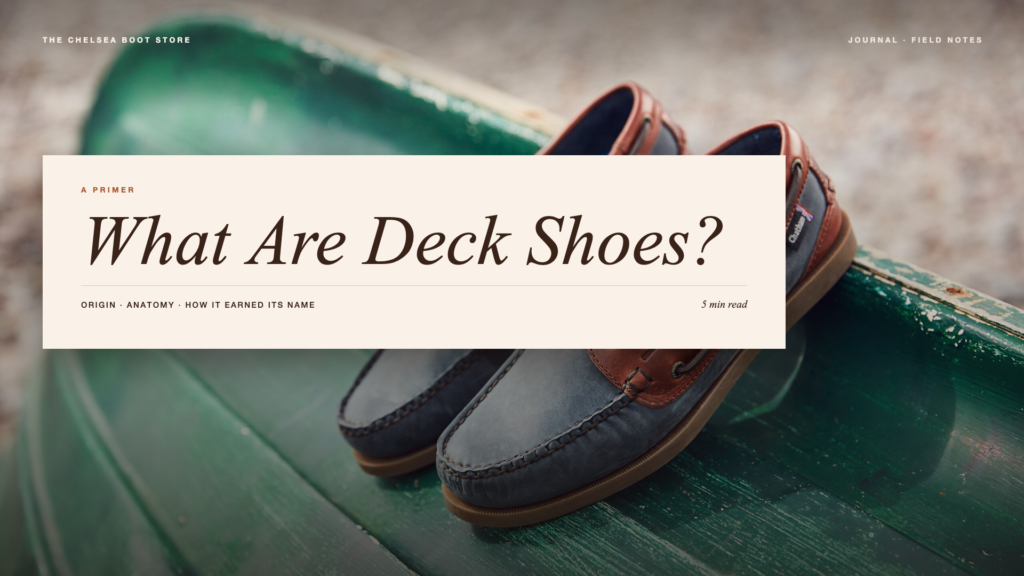
Deck shoes are low-profile leather footwear designed originally for use on boat decks, characterised by their siped rubber soles, hand-stitched construction and relaxed lacing system. While their origins are firmly nautical, deck shoes have long since moved beyond the marina. They are now one of the most recognisable pieces of British casual footwear and a warm-weather wardrobe staple for men and women across the UK.
Understanding what deck shoes are, how they are built and why they perform as they do makes it considerably easier to choose the right pair and wear them well.
The Origins of the Deck Shoe
The modern deck shoe was invented by American sailor Paul Sperry in 1935. Frustrated by the lack of grip on wet boat decks, Sperry found his inspiration by watching his cocker spaniel move across ice without slipping. He noticed the network of fine channels in the dog’s paw pads and applied the same principle to a rubber sole, creating a pattern of razor-thin cuts that channelled water away from the contact surface and dramatically improved grip on wet, smooth ground.
The resulting sole, known as a siped sole, became the defining feature of the deck shoe. Sperry’s design was adopted by the United States Navy during the Second World War and quickly became standard issue footwear for sailors who needed a reliable grip on wet decks without damaging the surface beneath.
In the UK, the deck shoe gained popularity through the 1960s and 1970s, first within sailing communities and then gradually within broader casual culture. British brands developed their own interpretations, drawing on the same principles of non-slip soles and durable leather uppers while bringing their own design sensibilities to the silhouette. Chatham, founded in 1989, became one of the most recognised British deck shoe brands, building on a coastal and marine heritage that remains central to everything they produce.
What Makes a Deck Shoe Different
Several specific design features define a deck shoe and distinguish it from other casual leather footwear. Understanding these features explains both why deck shoes perform as they do and why they look the way they look.
The Siped Sole
Siping refers to the pattern of thin cuts made across the surface of a rubber sole. These cuts flex open under pressure, creating channels that direct water away from the contact point and maintain grip on smooth, wet surfaces. On a boat deck, this prevents slipping on fibreglass, wood, or metal that is soaked by rain or sea spray.
On land, siped soles provide reliable traction on wet pavements, coastal paths and grass, which makes deck shoes a practical choice well beyond the sailing context. Quality deck shoes use non-marking rubber that leaves no scuff marks on wooden or polished surfaces, a feature that originates directly from their nautical use, where preserving the deck surface was a genuine practical concern.
Construction and Upper Materials
Quality deck shoes are made from full-grain leather uppers that are hand-stitched and finished. The stitching runs around the perimeter of the shoe, joining the upper to the sole in a construction that is both durable and resistant to moisture. Salt-resistant leather finishing is a feature commonly found on well-made British deck shoes, reflecting the marine environment for which they were designed. It prevents the white salt residue that can appear on standard leather after exposure to sea spray or coastal conditions, which is a specific and genuine practical benefit for anyone wearing them near the coast.
Key material and construction details found in quality deck shoes:
- Full-grain leather upper: The highest grade of leather, retaining the natural grain surface. More durable than corrected-grain or split leather and ages more gracefully with conditioning
- Salt-resistant treatment: A finishing process that protects the leather against the corrosive effects of salt water and sea spray. Chatham use this treatment as standard across their deck shoe range
- Hand-stitched perimeter construction: Stitching around the edge of the shoe joins the upper to the sole and provides additional water resistance at the point where the two materials meet
- Non-marking rubber sole: Marine-grade rubber that provides grip without leaving marks on boat decks, varnished wood or polished stone floors
Goodyear Welted Construction
Some deck shoes, including those produced by Solovair in England, are built using Goodyear welt construction. In this method, the upper, welt and sole are stitched together in a three-layer system that allows the sole to be replaced independently of the upper when it wears through. This significantly extends the working life of the shoe and is a mark of quality construction that justifies the higher cost of entry. Solovair has been making Goodyear welted footwear in England since 1881, and a well-maintained pair built to this standard can last many years before requiring anything beyond resoling.
The Lacing System
Traditional deck shoes use a lacing system that passes through the shoe in a loop around the perimeter, often described as 360-degree lacing. The lace distributes tension evenly across the upper rather than just across the tongue, providing a more secure and adjustable fit. The lace ties at the side or at the front, depending on the specific style.
This system keeps the shoe securely on the foot without a stiff heel counter or ankle support, contributing to the easy, relaxed feel deck shoes are known for while still maintaining a secure fit on unpredictable surfaces.
From Nautical Workwear to Everyday Lifestyle Shoe
The transition of the deck shoe from functional sailing footwear to mainstream lifestyle shoe followed a familiar path. Practicality and durability, combined with a clean and unfussy aesthetic, made deck shoes appealing beyond their original context in the same way the Chelsea boot and the Breton shirt moved from working origins into everyday wardrobes.
In the UK, this transition was aided by the country’s coastal culture and the popularity of sailing as both a professional and leisure pursuit. By the 1980s, deck shoes had become firmly associated with coastal towns, pub gardens, regattas and relaxed summer dressing. That association has proved durable and continues to define how deck shoes are understood and worn today.
Chatham’s deck shoes reflect this evolution directly. Built with marine-grade materials and non-marking soles, they are practical enough for genuine sailing use while refined enough for everyday wear in town and country. Solovair’s Goodyear welted deck shoes bring British manufacturing heritage and construction quality that suits buyers who want a deck shoe built to last well beyond a single season.
Frequently Asked Questions
What makes deck shoes different from regular casual shoes?
The siped rubber sole is the defining difference. It provides grip on wet, smooth surfaces in a way that standard leather or rubber soles do not. Non-marking rubber, salt-resistant leather finishing and hand-stitched construction are additional features specific to quality deck shoes that regular casual shoes do not typically include.
Are deck shoes waterproof?
Deck shoes are water-resistant rather than waterproof. The leather uppers resist moisture, and the siped rubber sole handles wet surfaces effectively, but prolonged exposure will allow water to penetrate. Regular application of a leather waterproofing product significantly extends its water resistance. Chatham uses salt-resistant leather specifically to handle coastal and marine conditions better than standard leather.
Why are deck shoes called deck shoes?
The name comes directly from their original purpose: footwear designed for use on the deck of a boat. The siped rubber sole that prevents slipping on wet deck surfaces is the feature that earned them the name, and it remains the most distinctive functional characteristic of the shoe.
Can women wear deck shoes?
Yes. Deck shoes are a genuinely unisex style. Solovair’s deck shoe is listed as unisex at The Chelsea Boot Store. Chatham also produces women’s deck shoes, available separately in the women’s range.
What is a siped sole on a deck shoe?
Siping refers to a pattern of thin cuts across the surface of the rubber sole. These cuts flex open under foot pressure, channelling water away from the contact point and maintaining grip on wet, smooth surfaces such as boat decks, wet stone or polished floors. The technique was developed by Paul Sperry in 1935, inspired by the grip pattern in his dog’s paw pads.
How long do deck shoes last?
A well-made pair of deck shoes, properly maintained, will last several years. Goodyear welted construction, as used by Solovair, allows the sole to be replaced independently of the upper, which significantly extends the shoe’s lifespan. Regular cleaning, conditioning and waterproofing keep the leather in good condition and prevent premature wear.