
No products in the basket.
Articles
Are Deck Shoes Smart or Casual?
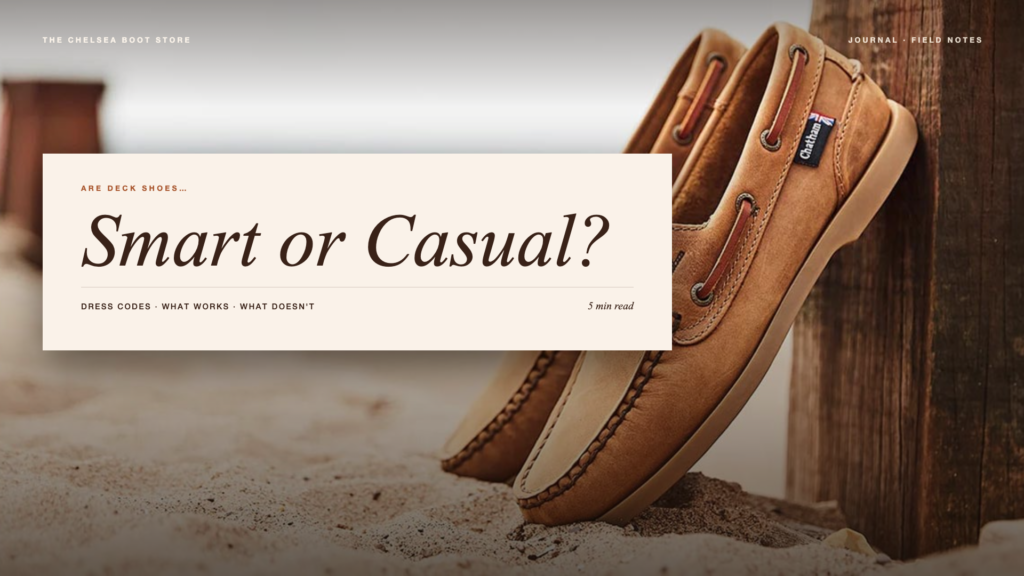
The honest answer is that deck shoes sit primarily in the casual to smart casual register, with the ability to lean further towards smart depending on the quality of the shoe, the colour chosen and the outfit they are paired with. They are not formal footwear, and no amount of high-quality leather or careful styling changes the fundamental character of a shoe with a siped rubber sole and a nautical origin. What they offer within the casual and smart casual spectrum, however, is considerable.
Understanding where deck shoes sit, what pulls them towards smart and what keeps them firmly casual, is worth knowing before buying and essential before wearing them somewhere unfamiliar.
What Keeps Deck Shoes in the Casual Register
Several features are inherent to the deck shoe that anchor it in casual territory regardless of how the shoe is styled.
The siped rubber sole is the most obvious. Rubber soles read as casual in most contexts, and while the specific pattern of a deck shoe sole is distinctive and well-finished, it does not carry the formal signal of a leather sole. The low, flat profile and the visible stitching detail of a moccasin-toe construction also read as relaxed rather than refined.
The cultural association the shoe carries matters equally. Deck shoes are firmly rooted in coastal, maritime and outdoor leisure culture. That association contributes to how they are perceived, regardless of material quality, which places a natural ceiling on how smart they can read in any given context.
What Pulls Deck Shoes Towards Smart Casual
Within the casual spectrum, the quality of the shoe makes a meaningful difference to how refined it appears in practice.
A deck shoe made from full-grain leather with hand-finished details, salt-resistant treatment and a clean, well-maintained sole reads considerably better in a smarter context than a lower-quality synthetic or poorly maintained leather version. Chatham deck shoes, built with marine-grade leather and hand-finished construction, carry a level of refinement that suits smart casual occasions well. A worn, scuffed or poorly maintained deck shoe of any quality sits firmly at the casual end and will read accordingly.
Colour shapes the register significantly:
- Tan leather: The most relaxed-reading option. Works in all casual and smart casual contexts but does not carry the same visual weight as darker leather in smarter settings
- Dark brown leather: A step up in formality from tan. Works in smart casual settings more comfortably and reads as slightly more considered and intentional
- Navy leather: The most refined-reading option available in deck shoes. Pairs naturally with lighter-coloured chinos and suits smart casual summer occasions most comfortably of the three
Construction also plays a role. A Goodyear welted deck shoe, such as those produced by Solovair, has a structural integrity and visual weight that a soft moccasin construction does not. The firmer upper and more defined sole create a shoe that reads slightly more serious while remaining fundamentally casual in character.
Where Deck Shoes Work in a Smart Context
Smart casual summer occasions are where deck shoes genuinely earn their place as an alternative to more formal footwear. The range of events and settings where a quality pair of deck shoes is entirely appropriate is broader than many people assume:
- Garden parties and outdoor summer gatherings: A quality leather deck shoe is an entirely appropriate choice for summer garden events where the ground is unpredictable and a smart casual dress code applies
- Coastal and waterside dining: The maritime origin of the shoe makes it the natural choice in coastal settings. A pair of Chatham deck shoes at a harbourside restaurant or coastal pub requires no justification
- Regattas and sailing events: The original context for the shoe. No other footwear is more appropriate
- Relaxed outdoor summer weddings: An outdoor or coastal summer wedding with a smart casual dress code can accommodate deck shoes in dark brown or navy leather paired with tailored chinos and a linen blazer
- Weekend city dressing in warm weather: A quality leather deck shoe in a considered summer outfit reads well in urban settings where a trainer would feel too casual and a Chelsea boot too heavy for the season
Where Deck Shoes Do Not Work
There are clear contexts where deck shoes are not the right choice, and being direct about those limits is more useful than hedging.
Formal occasions, weddings with a strict dress code, business meetings, black tie or traditional office environments — are not appropriate settings for deck shoes. The casual character of the shoe is inherent and will read as underdressed regardless of leather quality or outfit effort.
In colder months, deck shoes are also not the right choice. The low profile provides no ankle protection, the siped sole is designed for wet smooth surfaces rather than cold or icy ground, and the overall weight of the shoe is proportionally light for autumn and winter dressing.
The Outfit Determines the Register
More than the shoe itself, the outfit it is paired with determines how casual or smart deck shoes read on any given occasion. The same pair of navy leather Chatham deck shoes will read very differently depending on context.
Paired with navy slim chinos, a white Oxford cloth shirt and an unstructured linen blazer, they read as smart casual and appropriate for a summer social occasion. Paired with mid-wash jeans, a printed T-shirt and a zip-up sweatshirt, the same shoes read as relaxed weekend wear. The shoe has not changed. The outfit context has shifted the register entirely.
This flexibility is one of the genuine strengths of a quality deck shoe and the reason they represent a practical investment for warm-weather dressing. A shoe that moves between registers without looking out of place is a simple and versatile piece of footwear for anyone who values building a coherent wardrobe with fewer, better pieces.
Frequently Asked Questions
Are deck shoes appropriate for work?
In most formal or traditional office environments, deck shoes are not appropriate. In smart casual or creative workplaces with a relaxed dress code, a quality leather deck shoe in dark brown or navy leather, paired with slim tailored trousers and a plain shirt, may be acceptable depending on the specific workplace culture. They are not suited to formal business dress of any kind.
Can you wear deck shoes to a wedding?
Deck shoes can work at outdoor or coastal summer weddings with a smart casual dress code. A dark brown or navy leather deck shoe in excellent condition, paired with well-fitted chinos and a linen blazer, reads as considered summer dressing in the right outdoor or coastal context. For formal church weddings or events with a strict dress code, a leather Oxford or loafer is the more appropriate choice.
Are deck shoes smart enough for a restaurant?
Yes, for most restaurant settings. A quality leather deck shoe is appropriate for casual and smart casual dining, particularly in coastal, outdoor or summer contexts. For formal fine dining with a dress code, a more formal shoe is advisable.
What makes deck shoes look smarter?
Darker leather, better construction quality, a clean and well-maintained finish, and thoughtful outfit pairing all push deck shoes towards the smarter end of their natural range. Dark brown or navy leather reads more formally than tan. Paired with slim tailored chinos and a plain or lightly checked shirt, the overall look is considerably more refined than the same shoe worn with jeans and a casual top.
Do deck shoes look good with a suit?
No. Deck shoes are casual footwear and do not suit a suit in any context. The rubber sole, the low profile and the nautical aesthetic conflict with the formality of a suit, regardless of how the rest of the outfit is assembled.
Are deck shoes in fashion?
Deck shoes are not trend-dependent footwear. They entered the British wardrobe decades ago and have remained there through changing trends because their practicality and clean aesthetic are genuinely useful rather than fashionable. A quality pair of leather deck shoes from a reputable British brand is not a trend purchase and will not date in the way that more fashion-driven footwear does.