
No products in the basket.
Articles
History of the Chelsea Boot
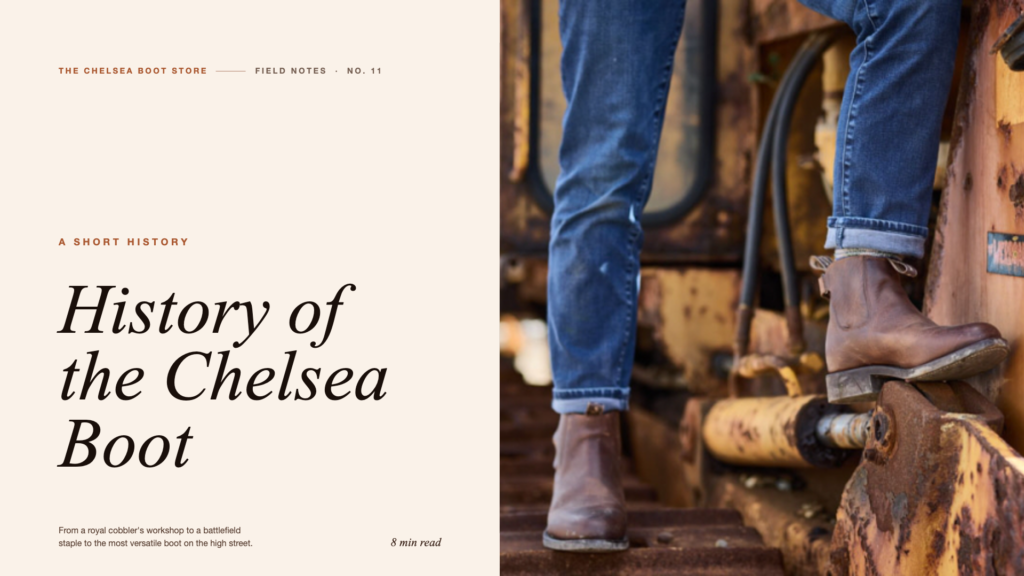
Few footwear styles have proven as durable as the Chelsea boot. From Victorian riding boots to the King’s Road in the 1960s, through multiple decades of reinvention, the Chelsea boot has outlasted trends, subcultures and shifting fashion cycles by remaining genuinely useful rather than fashionable. That usefulness, rooted in a simple and well-resolved design, is what makes its history worth understanding.
Origins: Victorian England and the Elastic Revolution
The Chelsea boot’s story begins in the 1840s, at the precise moment a new material became available to shoemakers for the first time. Vulcanised rubber, developed independently by Charles Goodyear in America and Thomas Hancock in England during the early part of that decade, made elastic practical for the first time. Before vulcanisation, rubber-based materials degraded quickly in heat and cold. The vulcanisation process stabilised rubber and opened the door to elastic that could be woven into fabrics and used structurally within footwear.
J. Sparkes-Hall, bootmaker to Queen Victoria, was among the first to apply this innovation to boot design. In his 1851 catalogue, Sparkes-Hall described a boot with elastic side panels that could be pulled on and off without fastening, forming a close and comfortable fit around the foot and ankle. Queen Victoria is reported to have worn the style herself for horse riding, lending it an immediate prestige that filtered through Victorian society.
The elastic-sided boot served a practical purpose within Victorian riding culture that goes beyond comfort. A rider needed a boot that could be pulled on and off quickly without assistance, that held firmly against the foot and ankle during physical activity, and that provided a clean, unobstructed line against the stirrup. The elastic side panel solved all three requirements simultaneously, and the design was adopted rapidly across riding and country circles.
The elastic gore used in the original construction was typically made from vulcanised rubber thread woven into a textile panel, a construction method that remains essentially unchanged in quality in Chelsea boots produced today. The durability of that original design solution is part of what explains why the boot has never required significant re-engineering.
From Riding Boot to Fashion Statement: The 1960s
The Chelsea boot in its modern form, and the name it carries, comes directly from the King’s Road in Chelsea, London, in the late 1950s and early 1960s. The King’s Road was the epicentre of British youth culture during this period, home to boutiques, artists, musicians and the loosely defined group of fashion-conscious young Londoners known as the Chelsea Set.
Bootmakers and cobblers along and around the King’s Road, most notably Anello and Davide, began producing elastic-sided boots with a sharper, more streamlined profile than the traditional Victorian riding boot. The pointed toe and slim silhouette gave the elastic-sided boot a modern edge that suited the angular, anti-establishment aesthetic of early 1960s British youth culture. The boot was adopted quickly and enthusiastically.
The Beatles wore Chelsea boots consistently throughout their early career, a fact that had an outsized influence on the style’s global reach. Their appearance in polished Chelsea boots at public events, on album covers and in filmed performances broadcast internationally effectively converted the boot from a London in-crowd choice to a worldwide fashion statement within a very short period. The Rolling Stones, The Kinks and a broad sweep of the British Invasion generation followed suit, cementing the Chelsea boot as the definitive footwear of 1960s British music culture.
The mod scene, which emerged from London in the early 1960s and spread rapidly through British youth culture, also adopted the Chelsea boot as part of its defining uniform. The clean silhouette, the absence of visible fastening and the sharp toe profile fitted the mod aesthetic of sharp tailoring and considered minimalism precisely. The boot became one of the most recognisable visual markers of the period.
The 1970s and Glam Rock
The Chelsea boot did not disappear when the mod scene gave way to new movements. In the early 1970s, it was adopted by glam rock and became central to the visual language of artists including David Bowie, Marc Bolan and the wider glam movement. Often produced with a more pronounced stacked heel and in more theatrical colourways and materials than the standard black leather versions of the 1960s, the glam-era Chelsea boot pushed the silhouette into more openly expressive territory while retaining the elastic panel and clean upper that defined the original.
The stacked heel Chelsea boot, which elevated the wearer several inches and created a deliberately theatrical presence, became one of the defining visual memories of the glam era and represents one of the furthest points from the practical riding boot that the Chelsea boot design has ever travelled while remaining recognisably itself.
Punk, Britpop and Beyond
Punk’s relationship with Chelsea boots was complicated. The movement largely rejected the elegant associations the boot carried and favoured more confrontational footwear, but the clean, workwear-adjacent versions of the Chelsea boot survived on the periphery. Post-punk and new wave musicians reintroduced stripped-back versions of the boot, and through the 1980s, it maintained a steady presence in British subcultural dressing.
Britpop brought the Chelsea boot back to the mainstream. Oasis, whose aesthetic was deeply rooted in 1960s British music culture, wore Chelsea boots throughout the mid-1990s at the height of their popularity, and the boot’s association with working-class British authenticity aligned naturally with the Britpop movement’s cultural positioning. A generation of British men reconnected with the style through that association, and the post-Britpop years saw Chelsea boots become a mainstream wardrobe staple rather than a subcultural marker.
The Modern Chelsea Boot
Today, the Chelsea boot occupies a position no other boot style quite matches. It is produced across a price range from fashion-label fast fashion to handcrafted British-made options built to last decades. It is worn by men and women, across multiple dress codes, in countries far removed from the King’s Road, where it acquired its name.
The fundamental design has not changed since J. Sparkes-Hall described it in 1851. Two elastic side panels, a pull loop at the heel or toe, a leather upper and a clean, unbroken ankle profile. The materials, construction standards and sole designs have evolved considerably, but the principle that made the boot practical in a Victorian riding yard remains exactly what makes it practical on a contemporary urban commute.
That continuity, a design so well-resolved that it requires no structural revision across 175 years, is the clearest explanation for why the Chelsea boot has outlasted every trend it has ever been associated with.
Frequently Asked Questions
Who invented the Chelsea boot?
The elastic-sided boot is most commonly attributed to J. Sparkes-Hall, bootmaker to Queen Victoria, who described the design in his 1851 catalogue. The elastic side panels were made possible by the development of vulcanised rubber in the early 1840s by Charles Goodyear and Thomas Hancock. Queen Victoria is reported to have worn the style for riding.
Why are they called Chelsea boots?
The name comes from the King’s Road in Chelsea, London, where bootmakers and boutiques popularised a sharper, more streamlined version of the elastic-sided boot in the late 1950s and early 1960s. The area was the centre of British youth fashion and music culture during that period, and the boot’s association with the Chelsea Set gave it the name that has remained ever since.
Did The Beatles wear Chelsea boots?
Yes. The Beatles wore Chelsea boots consistently throughout their early career, and their high profile brought the style global attention. Their appearance in Chelsea boots on album covers and in filmed performances during the early 1960s played a significant role in converting the boot from a London fashion trend to an internationally recognised style.
How old is the Chelsea boot design?
The elastic-sided boot was first designed in 1851, making the fundamental design over 170 years old. The modern version of the boot, with the sharper toe profile and streamlined silhouette now associated with Chelsea boots, was developed in the late 1950s and early 1960s along the King’s Road in London.
Have Chelsea boots always been popular?
Chelsea boots have maintained a consistent presence in British footwear since the 1960s, with notable periods of heightened visibility during glam rock in the 1970s and Britpop in the 1990s. Rather than going in and out of fashion dramatically, the boot has functioned as a wardrobe staple across multiple decades, adopted by different subcultures and generations for different reasons, while the underlying design remained unchanged.
Why have Chelsea boots remained popular for so long?
The design solves a practical problem so effectively that it has never needed significant revision. A boot that can be pulled on and off quickly, holds securely around the foot without lacing, and provides a clean, streamlined silhouette that works across dress codes is genuinely useful rather than simply fashionable. That utility, combined with the cultural associations accumulated over 60 years of mainstream wear, explains why the Chelsea boot has outlasted every trend it has been associated with.