
No products in the basket.
Articles
The Best British-Made Men’s Chelsea Boots
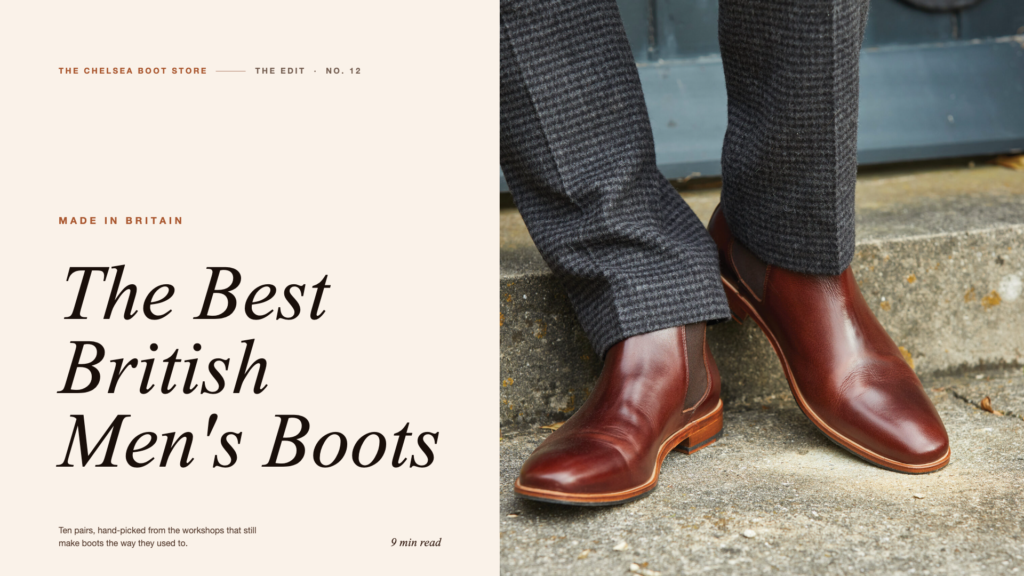
British Chelsea boots and bootmaking have a manufacturing heritage that is straightforward to talk about and considerably harder to sustain. The combination of traditional construction methods, high-grade leather sourcing and skilled hand-finishing that defined the industry for over a century has narrowed to a smaller number of producers than it once contained, but those that remain are producing footwear to a standard that is difficult to match at equivalent price points from elsewhere.
For buyers who want Chelsea boots made in Britain, understanding which brands still manufacture domestically, what construction methods they use, and what distinguishes one from another makes the buying decision considerably more straightforward.
Why British-Made Chelsea Boots Matter
The case for buying British-made boots is both practical and historical. On the practical side, domestic manufacturing allows for closer quality control, shorter supply chains and, in many cases, direct access to repair and resoling services that extend the boot’s working life well beyond what a mass-produced import could sustain. On the historical side, British bootmaking, particularly in Northamptonshire and the broader Midlands, developed specific construction techniques and leather sourcing standards over more than a century that continue to shape what the best British-made boots look and feel like.
Specific features that distinguish genuinely British-made boots:
- Blake Stitch and Goodyear welt construction: Both methods stitch the sole to the upper in ways that allow resoling, significantly extending the lifespan of the boot beyond what a cemented or glued construction permits
- Hand-finishing: Stitching, edge finishing and quality checking are completed by hand at each stage of production rather than being automated at high volume. This creates a standard of consistency and detail that is difficult to replicate at scale
- Lifetime repair guarantees: Some British manufacturers offer lifetime repair guarantees on their footwear, reflecting the confidence that genuinely handmade construction justifies and providing the buyer with a long-term relationship with the product rather than a transaction
- Tannery relationships: British bootmakers who have operated for generations often have established relationships with specific tanneries, giving them access to leathers selected specifically for their construction requirements rather than bought in bulk from a general supplier
GORAL: Sheffield, England Since 1936
GORAL has made footwear in Sheffield since 1936, over 80 years of continuous production in the same city, using Blake Stitch construction throughout. The Blake Stitch method stitches through the insole, upper and outsole in a single pass, creating a slim and flexible construction that sits closer to the foot than the Goodyear welt and allows the sole to be replaced independently when it wears through.
GORAL’s approach to materials is worth noting specifically. The brand sources hand-picked leathers from trusted tanneries, including Horween Chromexcel leather from the United States, one of the most respected leather tanneries in the world, which produces a full-grain leather with a natural pull-up finish that develops colour and character with wear. This is not a detail that can be retrofitted to lower-quality construction. The leather performs because the construction is sound enough to use it properly.
Every pair of GORAL boots is quality-checked by the craftspeople who made them before leaving the Sheffield workshop. The brand offers a lifetime repair guarantee on all footwear, which reflects both the construction standard and the expectation that a well-made GORAL boot should remain in service for many years with appropriate care and periodic resoling.
The Chelsea Boot Store stocks GORAL’s Baslow Chelsea Boot, a classic elastic-sided boot built on the brand’s traditional last using Horween Chromexcel leather and a durable TPU sole. For buyers who want a Chelsea boot that represents a genuine long-term investment in British manufacturing, the Baslow is one of the most substantive options available in that price category.
Solovair: Northamptonshire, England Since 1881
Solovair‘s history is one of the longest unbroken manufacturing stories in British footwear. Founded in 1881 in the village of Wollaston, Northamptonshire, under the original name of the Northamptonshire Productive Society, the company began as a workers’ cooperative and has continued producing footwear in England in the same county ever since. For approximately three decades from the mid-1950s, Solovair produced the original Dr Martens air-cushioned sole boots under licence, making them a central part of one of the most culturally significant footwear stories in British history, even if that connection is not widely known.
Today, Solovair uses Goodyear welt construction across its range. In Goodyear welt construction, the upper is stitched to a welt strip, and the outsole is then stitched to the welt, creating a three-layer construction that keeps the upper and sole distinct and allows the sole to be replaced without disturbing the upper. This produces a boot that is more structured and slightly firmer on first wear than a Blake Stitch construction, but develops and improves with regular use, eventually moulding closely to the foot.
At The Chelsea Boot Store, Solovair’s deck shoe is listed as unisex and priced at £120, reflecting the brand’s positioning as accessible British-made footwear rather than luxury heritage pricing. For buyers who want Goodyear welted construction made in England and understand the long-term value that construction method represents, Solovair offers that standard at a price point that makes the investment straightforward.
How to Choose Between Them
The practical differences between GORAL and Solovair come down to construction method, aesthetic and what kind of ownership experience the buyer is looking for.
Blake Stitch construction, as used by GORAL, produces a slimmer, more flexible boot that sits closer to the foot. The sole profile is lower and the overall feel is slightly less structured than a Goodyear welted boot, which can make it more immediately comfortable for buyers not accustomed to welted footwear. Goodyear welt construction, as used by Solovair, produces a more structured boot with a slightly more defined sole profile. It requires a longer break-in period but produces a boot that improves considerably with wear.
For buyers who prioritise immediate wearability and a slimmer silhouette, GORAL’s Blake Stitch construction and Baslow’s Horween leather upper represent a strong starting point. For buyers who prioritise long-term durability, structural integrity and a recognisable British manufacturing heritage going back over 140 years, Solovair’s Goodyear welted construction delivers that standard at a price that reflects the manufacturing cost rather than a premium brand margin.
The Broader Case for Buying British Chelsea Boots
The decision to buy British-made boots is not only about the boot itself. It is a decision about where manufacturing skill and heritage are sustained. The number of workshops in England capable of producing hand-finished, resoleable leather boots at this standard is smaller than it was and will only remain viable if there is consistent demand for what they produce.
Both GORAL and Solovair produce footwear that can be worn, repaired and worn again for many years. Buying a pair from either brand is a different kind of purchase from buying disposable fashion footwear, and it is worth understanding that difference before spending the money.
Frequently Asked Questions
Are there still boots made in England?
Yes. GORAL has produced footwear in Sheffield since 1936 using Blake Stitch construction, and Solovair has manufactured in Northamptonshire since 1881 using Goodyear welt construction. Both produce resoleable boots handmade in England and available at The Chelsea Boot Store.
What is Blake Stitch construction?
Blake Stitch is a construction method in which a single stitch passes through the insole, upper and outsole in one pass, creating a slim, flexible construction that sits close to the foot. It allows the sole to be replaced when worn through, significantly extending the lifespan of the boot. GORAL use Blake Stitch construction across their range, produced in Sheffield.
What is the difference between Blake Stitch and Goodyear welt construction?
Blake Stitch stitches through the insole, upper and outsole in a single pass, producing a slimmer, more flexible construction. Goodyear welt uses a three-layer system where the upper is stitched to a welt strip, and the outsole is then stitched to the welt separately. Goodyear welt produces a more structured boot with a more defined sole profile, and allows the sole to be replaced without disturbing the upper.
Why did Solovair make Dr Martens boots?
From the mid-1950s to the mid-1980s, Solovair produced Dr Martens boots under licence, manufacturing the original air-cushioned sole boots that became one of the most culturally significant footwear styles in British history. The two brands have operated independently since then, with Solovair continuing to manufacture Goodyear welted footwear in Northamptonshire.
Are British-made Chelsea boots worth the money?
Yes, provided the higher cost reflects genuine manufacturing quality rather than branding. Blake Stitch and Goodyear welted boots made in England can be resoled and maintained for many years, meaning the cost per year of use, over the realistic life of a well-maintained pair, compares very favourably with cheaper alternatives that need replacing entirely when they wear through.
Does GORAL offer a lifetime repair guarantee?
Yes. GORAL offers a lifetime repair guarantee on their footwear, reflecting the confidence that comes with handmade Blake Stitch construction produced in their Sheffield workshop. This is a meaningful long-term commitment that distinguishes genuinely handmade footwear from mass-produced alternatives.