
No products in the basket.
Articles
The Best Men’s Boots for Autumn
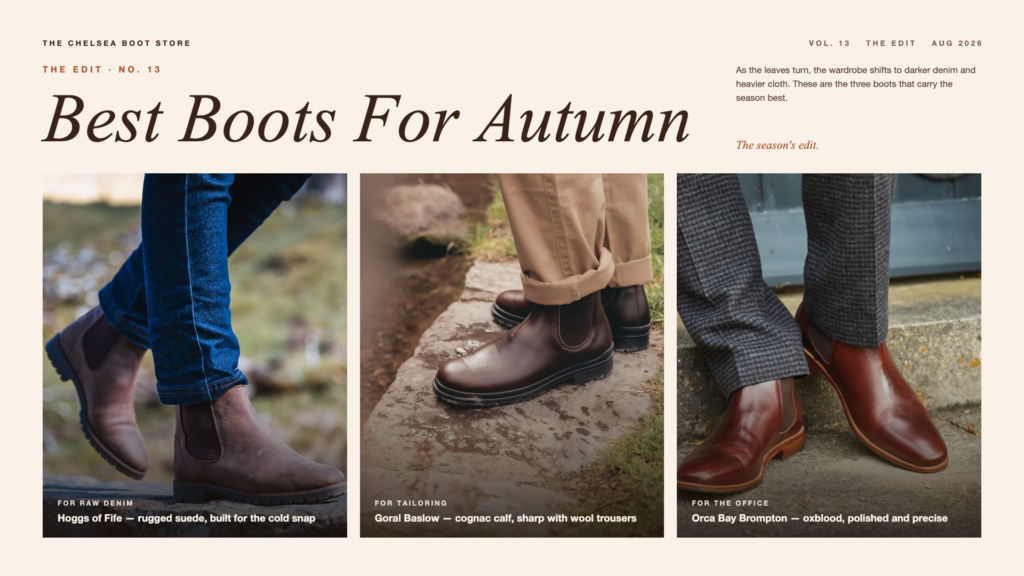
Autumn changes what a boot needs to do. The ground shifts from dry to damp, temperatures drop enough to make sole warmth and liner quality noticeable, and the lighter footwear of summer starts to feel inadequate for anything beyond a dry day in town. A boot that performs well in autumn is not simply a boot with a heavier sole; it is a combination of waterproof or water-resistant leather, adequate grip across wet surfaces, a lining that manages moisture without trapping heat, and a construction robust enough to handle repeated wet and dry cycles without deteriorating quickly.
This guide covers the best men’s boot options for autumn, what makes each one suited to the season, and how to choose based on how you actually use them.
What Autumn Demands From Boots
Before covering specific options, the functional requirements of an autumn boot are worth establishing clearly, because they narrow the field considerably.
- Water resistance: Autumn in the UK means persistent damp rather than sustained heavy rain. A boot needs to resist moisture across a full day of walking rather than simply repelling a single downpour. Full-grain leather treated with a waterproofing product performs well in this context, and rubber soles seal the lower perimeter against wet ground more effectively than leather soles
- Grip on mixed surfaces: Wet leaves, wet stone, mud at path edges and damp pavement all behave differently underfoot. A sole with a defined tread pattern rather than a smooth or minimal profile provides noticeably better traction across the range of surfaces autumn walking involves
- Temperature management: A boot that is too warm in early October will be uncomfortable. A boot with no lining or insulation will feel cold in November. Autumn spans a wide temperature range, and a leather boot with a natural leather lining is generally better calibrated for that variation than a heavily insulated option
- Durability under repeated wet conditions: A boot that is repeatedly soaked and dried without adequate conditioning will dry out and crack. Leather quality and regular conditioning matter more in autumn than in the drier months, and a boot built to handle those conditions from the outset requires less maintenance effort to keep in good condition
Blundstone Chelsea Boots: Reliable All-Weather Performance
Blundstone boots are a strong starting point for autumn because they remove most of the friction points associated with changing weather. The rubber outer sole provides grip and warmth underfoot, the full-grain leather upper resists moisture effectively, and the thermal regulation of Blundstone’s lining suits the variable temperatures of autumn more reliably than many alternatives.
Blundstone boots require no break-in period and transition from summer to autumn use without any adjustment. For buyers who want a boot that handles wet commutes, damp weekend walks and mixed urban and light rural conditions without demanding careful management, Blundstone covers the majority of autumn use cases competently and at a price that reflects the practical value they deliver.
Models worth considering for autumn specifically include the 587 in Rustic Brown and the 585 in Antique Brown, both of which use a thermal insole suited to cooler temperatures while remaining light enough to avoid the weighted feeling of a heavily constructed winter boot.
Orca Bay Chelsea Boots: Structured Support for Town and Country
Orca Bay Chelsea boots suit buyers who want an autumn boot capable of moving between smart casual and country contexts without needing to be changed. The structured leather construction and refined profile hold up well across autumn conditions, and the quality of leather used across Orca Bay’s range means the boots maintain their shape and appearance through repeated wet days better than cheaper alternatives.
The Orca Bay Seaham, available in a range of leather finishes, provides a slightly more robust sole profile than purely dress-oriented Chelsea boots while retaining the clean silhouette that works in town as well as on a country walk. For buyers who spend autumn Saturdays somewhere between a market town and a country pub, Orca Bay sits comfortably in that middle ground.
GORAL: Long-Term Investment for Discerning Buyers
GORAL boots are not the obvious choice for buyers who want immediate ease, but for those who want an autumn boot that rewards long-term ownership, they represent one of the most substantive options available. Handmade in Sheffield using Blake Stitch construction and full-grain Horween Chromexcel leather, GORAL’s Baslow Chelsea boot develops and improves with each season of wear.
Horween Chromexcel leather responds particularly well to conditioning, developing a pull-up quality where scuffs and marks resolve with gentle pressure and the leather deepens in colour over time. For autumn specifically, this means a well-maintained GORAL boot looks better in its second and third autumn than it did in its first, which is not something that can be said of most footwear at any price point. The Blake Stitch construction allows resoling when the sole eventually wears through, making the long-term cost of ownership more favourable than disposable alternatives.
Harold Boot Company: Heavy Leather Boots for Colder Conditions
Harold Boot Company boots are built with a heavier leather construction than most Chelsea boots, which makes them particularly well-suited to the colder end of the autumn season. The additional weight and structure of the leather provide more protection from cold wind and damp than a lighter boot, and the generous fit accommodates a thicker sock without the internal volume becoming restrictive.
For buyers who spend the later autumn months outdoors regularly, whether walking, in country settings or in environments where the temperature drops noticeably in the afternoon, Harold Boot Co provides a level of protection that lighter Chelsea boots cannot consistently deliver.
Styling Boots in Autumn
The shift into autumn dressing changes, which outfit combinations work best with boots? The lighter palette and fabrics of summer give way to heavier textures, richer colours and more layered outfits, and the boots need to sit naturally within that shift.
- Cord trousers: Cord is one of the most natural autumn fabrics and pairs equally well with a Chelsea boot in dark brown or tan and a more robust country boot. A slim or straight-leg cord in olive, rust or camel provides warmth and texture without overwhelming the boot
- Heavy denim: Darker denim in heavier weights, around 13 to 14oz, drapes well around the ankle and provides a strong base for any dark leather boot. A clean turn-up sits naturally over a Blundstone or GORAL boot and exposes the boot clearly without requiring adjustment
- Waxed or heavy cotton jackets: Barbour-style waxed jackets and overshirts in heavy cotton suit country-oriented boots in tan or dark brown naturally. The fabrics share a register and a function that creates a coherent overall look
- Chunky knitwear: A heavy cable or textured knit worn over slim or tailored trousers with a Chelsea boot in dark leather is one of the most reliable smart casual autumn combinations. The textural contrast works without requiring the outfit to be overthought
Frequently Asked Questions
What makes a good autumn boot for men?
A good autumn boot needs water-resistant or waterproof leather, a defined sole profile for grip on wet surfaces, adequate liner temperature management for variable conditions, and construction robust enough to handle repeated wet and dry cycles. Full-grain leather treated with a waterproofing product, combined with a rubber or commando sole, covers most autumn requirements across different brands and construction types.
Are Chelsea boots suitable for autumn?
Yes. Chelsea boots in full-grain leather with a rubber sole, such as Blundstone or Orca Bay, handle autumn conditions well. The key is maintaining water resistance through regular conditioning and waterproofing and pairing the boot with an outfit that suits the heavier palette and textures of the season.
What are the best boots for wet autumn weather?
Blundstone boots are among the most practical options for wet autumn conditions, combining a rubber sole that seals against wet ground, a durable leather upper and reliable traction across damp surfaces. Orca Bay provides a more structured option for buyers who want to maintain a smarter appearance across similar conditions.
How should you waterproof leather boots before autumn?
Apply a leather waterproofing product to clean, dry leather before the first wet days of the season. Work the product thoroughly into the leather, paying particular attention to the seams and welt area where water most commonly penetrates. Allow to absorb fully before wearing. Reapply every four to six weeks during regular autumn use, or more frequently if the boots are exposed to sustained wet conditions.
Do leather boots need extra care in autumn?
Yes. Repeated wetting and drying cycles dry out leather faster than dry-weather use, meaning conditioning frequency should increase in autumn. Allowing boots to dry naturally after each wet outing, conditioning every three to four weeks, and applying a waterproofing spray at the start of the season significantly extends the working life and appearance of leather boots through the colder months.